Once it snowed 15 inches.
My father forayed into the backyard, with me trailing behind, frantically pulling on my plastic snow pants. I was too young to remember why or what mission we were on, but I knew that I needed to follow. My worried mother told me to walk in his footsteps. She knew she couldn’t stop me from leaving.
The footprints were large, rubber-made indentations. The steps to the patio had disappeared in a field of white. There was no sound. Snow makes everything pure and dead.
I could see at the bottom of my father's footprint holes where the tread had imprinted. Everything was white. His steps had sunk into the snow knee-deep.
I hopped from footprint to footprint where the patio used to be, I imagined myself a space man exploring new, hidden worlds, until it became quiet. I no longer saw him. Looking up, I still saw the trail of deep footprints I was too tired and too small to stumble through. My tepid heartbeat resonated in deadness of snow. I was alone and he’d gone too far up the hill for me to see or follow. Stillness was broken only by the occasional snowflake that fell like a careless death.
* * *
Many important men once walked here. They left their impressions that I marvel in and wonder at.
Someone built a part-Parthenon on Calton Hill. I am a part-Parthenon. I am an incomplete masterpiece. Every angle of the original Parthenon was designed to lift and exemplify human beauty. I felt I could have been a Parthenon. But I, like the Edinburgh’s Folly, am just a partial skeleton.
Grace has caressed, but not kissed me. I am destined to walk in the footprints of others. I am the dust brushed aside in the path of the Colossus.
But impressions are vacancies.
Thursday, November 15, 2007

Monday, November 12, 2007
American Expats in the UK
I cannot imagine how much more daunting, bewildering, and lonely this experience would be if not for the existence of the cyber community at American Expats in the UK. I have gained more information about how to prepare for relocation to the UK from that group of people than from all other sources combined. Visas and immigration laws - getting our cats into the country - international tax laws - how to get a bank account - rent and council tax... But as immeasurably valuable as their insight and experiences have been, so much greater is the gift of friendship in a strange land.
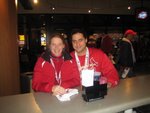
Friday night gathering of Am Expat members and friends at the Tass, a pub at the corner of the Royal Mile and St. Mary’s Street, with vegetarian haggis, whisky, lager, and traditional Scottish music:

The next day, lunch at the Buffalo Grill in Stockbridge:

After lunch and a walk through the city, taking in the view and the wind on top of Calton Hill:

Friday night gathering of Am Expat members and friends at the Tass, a pub at the corner of the Royal Mile and St. Mary’s Street, with vegetarian haggis, whisky, lager, and traditional Scottish music:

The next day, lunch at the Buffalo Grill in Stockbridge:

After lunch and a walk through the city, taking in the view and the wind on top of Calton Hill:

Status report
One week in. This city is amazing. I might even use the word 'perfect,' except that I have been repeatedly warned by natives and other expats alike about the long, cold, dark, wet winter that looms just around the bend. They keep predicting rain, but so far the rain has not come; it seems we chose the right week to make our first. I suspect that this winter, of which I hear so much, could prove to be Edinburgh's lone fault.

I have been in the office throughout this past week, except for 1 day which I took off. The newly constructed, window-lined building is excellent, as is its location at the border between the neighborhoods of New Town and Leith, and as are my friendly and jovial new coworkers. From my desk on the third floor (the second floor by British reckoning) I can look up cobblestoned Gayfield Place; the uphill street opens my view through the Georgian buildings toward Calton Hill in the distance. In the mornings, tendrils of steam drift from vents into the chill air, children make their way to St. Mary's Primary School (across the street), and seagulls meander past my window. By mid-morning the sun slants through, so I must lower the blinds; after a few hours, the glare has passed and they can be opened again.
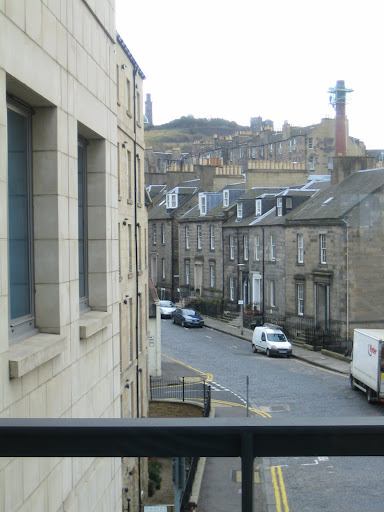

I have been in the office throughout this past week, except for 1 day which I took off. The newly constructed, window-lined building is excellent, as is its location at the border between the neighborhoods of New Town and Leith, and as are my friendly and jovial new coworkers. From my desk on the third floor (the second floor by British reckoning) I can look up cobblestoned Gayfield Place; the uphill street opens my view through the Georgian buildings toward Calton Hill in the distance. In the mornings, tendrils of steam drift from vents into the chill air, children make their way to St. Mary's Primary School (across the street), and seagulls meander past my window. By mid-morning the sun slants through, so I must lower the blinds; after a few hours, the glare has passed and they can be opened again.
Friday, November 2, 2007
Over the Atlantic
We are currently flying over the Atlantic. Despite a few delays, we are on our way to what some have called an adventure, some have called an experience, and others have called crazy. I don’t think too deeply about these decisions. I am afraid of talking myself out of such things. Negative thoughts can be poison, and we fill our heads with enough poison.
But the, “I don’t think we can (should) do it,” poison of the mind never really put up much of a fight this time. Usually, with decision rises doubt. Decision implies permanence. And, since nothing in reality has permanence, contradiction inevitably arises when permanence is declared. We don’t look at it as permanent. It is change. It is frightening, it is exciting. But it is only permanent if “home” and “proximity” become fixed ideals. And any fixed ideal is immediately poisoned by contradiction.
We were delayed in St. Louis, and again in Newark, New Jersey. Newark was where I saw my first brown sunset. Kelly, looking out the window at the haze of brown below us inquired, “is that Fall, or is that pollution?”
Beauty could not be Beauty without poison. In the immortality of the moment, Cleopatra, Socrates, and Hitler took poison. They became the ebb and flow of what we were. And what we are. And what we can be. We can be beautiful or we can be horrible. We even have the power to be or not be. It is all within our power of decision. We can decide to decide.
The rush of wind beneath wings guides an iron bird that can not exist without years of science, centuries of the mountain that crushed the iron, or the millenniums that magma furnaces grew the mountain. Despite whatever force now pulls us thousands of miles from our birthplace, people are comforting to people.
We fly on a plane that is comprised primarily of Scots. The syncopated accents and the orders of alcoholic beverages are a dead giveaway. When meeting new people I like to listen. I deciphered from the family behind us, that the little blonde boy wanted to keep a stray animal that had wandered into their Scottish house. He kept asking about a “gaaaayte” for the stairwell. His mother called the animal “little orphan Travis,” and brushed most of his questions aside with a hearty laugh.
That conversation could happen in any accent in any place in the world. The boy sees the faith, the companionship, and cuddly comfort. The parent sees the problems, the responsibility, and the shit. Somehow, we muddle through it. Neither were what they were. If the mother gets her way, or if the boy gets his, they will each be a bit changed. A bit wiser. A bit hardened, or a bit softened.
Each person is just a sum of his or her perceptions. No one exists without everything that has gone before. Everything is change. Nothing in reality exists that is not constantly changing. The mother’s heart softens to the innocent inquiries and logical constructions of the boy. The boy grows and learns that love is maintenance.
The sunset may be Fall or pollution. Death is not particular. Even as the cells in my body are dying and birthing, I change. The sea life stirs and dies and devours thousands of feet beneath me. There is not sadness in change. It is what is.
But I am no fool. I am lucky. I am luckier than 90% of the people who exist, or who have existed in their ebb and flow of toil. I could never write these words without family and friends whose sum I am the culmination of at this moment. These relationships and chemical equations that have created me and stretch back into infinity are the Truth of existence.
I, the sum these relationships, will grow, change, and metamorphose. I will never be “I” again. But this “I” never really was and never is. The Truth that fuels these relations is the connections that remain no matter how many miles separate. No man is an island and no man can exist without everything else that comprises reality. Love, hate, happiness, living, dying, and sadness are all a part of being. But the most important part of being is sharing.
Only by living together and sharing together can we die alone. It is the only thing that gives us comfort and truth in an otherwise distant, lonely, and conceptualized world. As strange as it sounds, I hope I grow closer to those I have left by leaving. At times my heart will ache, as it is designed to do, but those moments of joy upon rejoining… will not be unlike the astronauts who thought they were lost from the earth forever, feeling its gritty dust upon their feet, hands, mouths, and tongues. Truth is all around. But pettiness prevents me from appreciating it.
But the, “I don’t think we can (should) do it,” poison of the mind never really put up much of a fight this time. Usually, with decision rises doubt. Decision implies permanence. And, since nothing in reality has permanence, contradiction inevitably arises when permanence is declared. We don’t look at it as permanent. It is change. It is frightening, it is exciting. But it is only permanent if “home” and “proximity” become fixed ideals. And any fixed ideal is immediately poisoned by contradiction.
We were delayed in St. Louis, and again in Newark, New Jersey. Newark was where I saw my first brown sunset. Kelly, looking out the window at the haze of brown below us inquired, “is that Fall, or is that pollution?”
Beauty could not be Beauty without poison. In the immortality of the moment, Cleopatra, Socrates, and Hitler took poison. They became the ebb and flow of what we were. And what we are. And what we can be. We can be beautiful or we can be horrible. We even have the power to be or not be. It is all within our power of decision. We can decide to decide.
The rush of wind beneath wings guides an iron bird that can not exist without years of science, centuries of the mountain that crushed the iron, or the millenniums that magma furnaces grew the mountain. Despite whatever force now pulls us thousands of miles from our birthplace, people are comforting to people.
We fly on a plane that is comprised primarily of Scots. The syncopated accents and the orders of alcoholic beverages are a dead giveaway. When meeting new people I like to listen. I deciphered from the family behind us, that the little blonde boy wanted to keep a stray animal that had wandered into their Scottish house. He kept asking about a “gaaaayte” for the stairwell. His mother called the animal “little orphan Travis,” and brushed most of his questions aside with a hearty laugh.
That conversation could happen in any accent in any place in the world. The boy sees the faith, the companionship, and cuddly comfort. The parent sees the problems, the responsibility, and the shit. Somehow, we muddle through it. Neither were what they were. If the mother gets her way, or if the boy gets his, they will each be a bit changed. A bit wiser. A bit hardened, or a bit softened.
Each person is just a sum of his or her perceptions. No one exists without everything that has gone before. Everything is change. Nothing in reality exists that is not constantly changing. The mother’s heart softens to the innocent inquiries and logical constructions of the boy. The boy grows and learns that love is maintenance.
The sunset may be Fall or pollution. Death is not particular. Even as the cells in my body are dying and birthing, I change. The sea life stirs and dies and devours thousands of feet beneath me. There is not sadness in change. It is what is.
But I am no fool. I am lucky. I am luckier than 90% of the people who exist, or who have existed in their ebb and flow of toil. I could never write these words without family and friends whose sum I am the culmination of at this moment. These relationships and chemical equations that have created me and stretch back into infinity are the Truth of existence.
I, the sum these relationships, will grow, change, and metamorphose. I will never be “I” again. But this “I” never really was and never is. The Truth that fuels these relations is the connections that remain no matter how many miles separate. No man is an island and no man can exist without everything else that comprises reality. Love, hate, happiness, living, dying, and sadness are all a part of being. But the most important part of being is sharing.
Only by living together and sharing together can we die alone. It is the only thing that gives us comfort and truth in an otherwise distant, lonely, and conceptualized world. As strange as it sounds, I hope I grow closer to those I have left by leaving. At times my heart will ache, as it is designed to do, but those moments of joy upon rejoining… will not be unlike the astronauts who thought they were lost from the earth forever, feeling its gritty dust upon their feet, hands, mouths, and tongues. Truth is all around. But pettiness prevents me from appreciating it.
Friday, October 19, 2007
Quitting
I quit my job today.
I quit a bar-back job when Talayna couldn’t support the restaurant anymore. I quit Casa Gallardo when my hair grew too long. I quit Forest Hills Country Club twice. Once to make a point (which I was rehired upon making) and again when I went to college. I quit Turveys on the Green when I crashed my car. I quit the ditch-digging job out in Estes Park when I got tired of digging a sewer line for $7 a day. I quit Pagliai’s Pizza when there was a party one Saturday night in college. I quit bill collecting when a teaching job at an alternative school came along. And now, five years later, I am quitting that alternative school. I used to have nothing to lose. Quitting used to be easy.
I’ve never been locked onto the steps of a career ladder, so I’ve never really had to worry about how far I’ve climbed, or what lay above. I’ve never felt bad about quitting. I’ve always ended up some place better. However, this job wasn’t just a job. It wasn’t a career, but it was more important than the row of numbers that qualified as just compensation for the last two weeks of traded life.
Riverview was where I broke up my first fight. One of the kids was this little crack head named Deandre. He was always looking for trouble, cash, a good drug deal, and a new high. The other, John, was a quiet kid. He never picked any fights. He came in and did what his mom and brother wanted him to do. He read at a 3rd grade level, was stoned most of the time, and had no idea how to talk to girls. Once in the back office, he told me about how he and his brother showed up to a fight at the park a month ago, where dozens of guys were jumping out of vans with baseball bats and busting into each other. He wasn’t really sure what the fight was supposed to settle, he just knew the colors of which side he was on.
Deandre dashed across the room. It only took a look and a couple of words. Apparently, Deandre’s boys had tangled with John’s brother and come up short. It was up to Deandre to rebalance things by punishing the little brother who had nothing to do with the original altercation. So it goes in the feudalistic mentality that is clan warfare. Guilt by association. Guilt by blood. I grabbed them both. I heard Deandre’s shirt rip as I grabbed it, twisted it and slung him sideways. He stumbled to his knees. He was surprised and off-balance. I stiff-armed John and held my arm crooked. He leaned against it, but didn’t try to get around it. As much as these kids called each other “motherfucker,” they didn’t really want to fight. They never really do at first, unless they are really cold-blooded and have it all planned out. But once they have squared off and have an audience, they have no choice but to fight. After yelling at John to sit down, I dragged Deandre to the front door and literally threw him on his ass. As he sat there on the sidewalk, I went back into the center, picked up his hat, walked back to the door, threw it at his face and told him, “Don’t come back.” And he didn’t.
That is just one story of what must be a hundred. There was Martin, who had impregnated one of the girls in the center, had several other girlfriends, and another baby by another girlfriend. There was also the time that two of my students were pulled over by the cops in front of Walgreens and thrown on the ground, pistols waving. After the roughing-up it was determined to be a case of mistaken identity… but I started to understand why black kids had an “us-vs-them” mentality when it came to white cops.
Kevin and Kent made it through HVAC school. They visited to tell me about how Anthony had wrecked his car doing 100 mph on the highway, jacked up on all sorts of “stuff he shouldn’t been doing,” and killed himself.
You remember the successes because you can’t forget the tragedies.
I used to play chess every Friday with Vince. He had spent nine months in jail. He never told me what for, but from what I pieced together, it was probably a weapon used in a car-jacking. Jail had actually mellowed the kid out. He was twenty, came in stoned all the time, but had evolved beyond violence. He’d done his time. He had his badge. I guess the neighborhood didn’t mess with him anymore. He was a pretty good chess player after those nine months. He never beat me, but he came close a few times. The kids used to gather around and watch. I told them if he ever beat me, I would let them leave a half-hour early.
I have aged considerably since the early days in Riverview. Maybe I will get to all the stories in all the school districts eventually. But when you are dealing with the currency of children, rather than corporation, it becomes hard to leave. Today I left. It was probably the best bunch of kids I’ve ever abandoned, but most of them will be alright. There are only a few that I fear will end up like Anthony. One of them almost did. I gave him his diploma in a physical rehabilitation hospital. He had tubes in him, scars where tubes had been, and I am not sure he still had his feet. He had been that way for 5 months. In bed for five months. All because he and a friend had taken a high joy ride when an ice storm had hit. They were being stupid, sure. But some stupidity carries a life sentence, others get off easy.
Whatever the next horizon holds, the stories of hundreds of these children are coming with me, like a flock of birds. Some of them are lost, some of them have landed in pleasant lands, and some of them are yet to die. I have done what I can. All there is left to do is tell some of their stories I haven’t yet gotten to. There isn’t anyone else doing it.

I quit a bar-back job when Talayna couldn’t support the restaurant anymore. I quit Casa Gallardo when my hair grew too long. I quit Forest Hills Country Club twice. Once to make a point (which I was rehired upon making) and again when I went to college. I quit Turveys on the Green when I crashed my car. I quit the ditch-digging job out in Estes Park when I got tired of digging a sewer line for $7 a day. I quit Pagliai’s Pizza when there was a party one Saturday night in college. I quit bill collecting when a teaching job at an alternative school came along. And now, five years later, I am quitting that alternative school. I used to have nothing to lose. Quitting used to be easy.
I’ve never been locked onto the steps of a career ladder, so I’ve never really had to worry about how far I’ve climbed, or what lay above. I’ve never felt bad about quitting. I’ve always ended up some place better. However, this job wasn’t just a job. It wasn’t a career, but it was more important than the row of numbers that qualified as just compensation for the last two weeks of traded life.
Riverview was where I broke up my first fight. One of the kids was this little crack head named Deandre. He was always looking for trouble, cash, a good drug deal, and a new high. The other, John, was a quiet kid. He never picked any fights. He came in and did what his mom and brother wanted him to do. He read at a 3rd grade level, was stoned most of the time, and had no idea how to talk to girls. Once in the back office, he told me about how he and his brother showed up to a fight at the park a month ago, where dozens of guys were jumping out of vans with baseball bats and busting into each other. He wasn’t really sure what the fight was supposed to settle, he just knew the colors of which side he was on.
Deandre dashed across the room. It only took a look and a couple of words. Apparently, Deandre’s boys had tangled with John’s brother and come up short. It was up to Deandre to rebalance things by punishing the little brother who had nothing to do with the original altercation. So it goes in the feudalistic mentality that is clan warfare. Guilt by association. Guilt by blood. I grabbed them both. I heard Deandre’s shirt rip as I grabbed it, twisted it and slung him sideways. He stumbled to his knees. He was surprised and off-balance. I stiff-armed John and held my arm crooked. He leaned against it, but didn’t try to get around it. As much as these kids called each other “motherfucker,” they didn’t really want to fight. They never really do at first, unless they are really cold-blooded and have it all planned out. But once they have squared off and have an audience, they have no choice but to fight. After yelling at John to sit down, I dragged Deandre to the front door and literally threw him on his ass. As he sat there on the sidewalk, I went back into the center, picked up his hat, walked back to the door, threw it at his face and told him, “Don’t come back.” And he didn’t.
That is just one story of what must be a hundred. There was Martin, who had impregnated one of the girls in the center, had several other girlfriends, and another baby by another girlfriend. There was also the time that two of my students were pulled over by the cops in front of Walgreens and thrown on the ground, pistols waving. After the roughing-up it was determined to be a case of mistaken identity… but I started to understand why black kids had an “us-vs-them” mentality when it came to white cops.
Kevin and Kent made it through HVAC school. They visited to tell me about how Anthony had wrecked his car doing 100 mph on the highway, jacked up on all sorts of “stuff he shouldn’t been doing,” and killed himself.
You remember the successes because you can’t forget the tragedies.
I used to play chess every Friday with Vince. He had spent nine months in jail. He never told me what for, but from what I pieced together, it was probably a weapon used in a car-jacking. Jail had actually mellowed the kid out. He was twenty, came in stoned all the time, but had evolved beyond violence. He’d done his time. He had his badge. I guess the neighborhood didn’t mess with him anymore. He was a pretty good chess player after those nine months. He never beat me, but he came close a few times. The kids used to gather around and watch. I told them if he ever beat me, I would let them leave a half-hour early.
I have aged considerably since the early days in Riverview. Maybe I will get to all the stories in all the school districts eventually. But when you are dealing with the currency of children, rather than corporation, it becomes hard to leave. Today I left. It was probably the best bunch of kids I’ve ever abandoned, but most of them will be alright. There are only a few that I fear will end up like Anthony. One of them almost did. I gave him his diploma in a physical rehabilitation hospital. He had tubes in him, scars where tubes had been, and I am not sure he still had his feet. He had been that way for 5 months. In bed for five months. All because he and a friend had taken a high joy ride when an ice storm had hit. They were being stupid, sure. But some stupidity carries a life sentence, others get off easy.
Whatever the next horizon holds, the stories of hundreds of these children are coming with me, like a flock of birds. Some of them are lost, some of them have landed in pleasant lands, and some of them are yet to die. I have done what I can. All there is left to do is tell some of their stories I haven’t yet gotten to. There isn’t anyone else doing it.
O.B.O.
The first real punch to the gut came was when it was time to sell my car.
It didn't bother me to get rid of most of my things. It didn't upset me to sell off every piece of my 180-gallon saltwater aquarium, upon which I had spent several thousands of dollars and the better part of a year researching and assembling. Even bidding farewell to the beautifully hand-crafted walnut stand and canopy was met only with a mixture of relief and vague, barely considered regret.
It didn't frighten me when we moved everything out of our new rowhouse where we had expected to spend the next 30-odd years. Even the day we met our renters and gave them the keys, the garage door opener, and a few last instructions before entrusting our home to their keeping found me too distracted and harried to feel scared or sad.
Moving into my parents' house, the home of my childhood, was a return to the deeply familiar; setting a date for the termination of my cellphone service, cancelling our gym memberships, and forwarding our mail were minor tasks to check off a list; deciding on Mark's last day of work was a matter of course. Taking both cats to the vet was a duty that was long-overdue anyhow -- this time they just needed a few new procedures and a bit of extra attention to crossing the T's and dotting the I's. Submitting the various pieces of information and documentation to obtain my UK work permit and, subsequently, our visas was exacting, but -- ultimately only paperwork.
The day it hit me was the day I drove my red Mazda 6s -- pimped out with all the trimmings -- to the the nearest dealership and asked them if they would buy it from me.

I love my car, so logically this made me sad. The irrational part of me protested, how can I live without a car? and this made me scared. I don't really want them to buy it - not the man at the dealership or the random guy I might find on Craigslist. I don't want their money, and I don't want to hand them my keys. I have found myself pondering absurd notions like putting it into a garage somewhere or parking it on the street at one of our parents' houses. Like I said, absurd; the value drops nigh weekly on a used car, sitting still for lengthy (much less, indefinite) periods does a car no good, and a car is a great big, steel thing that takes up a lot of space and costs money whether you drive it or not. I understand this. At least, part of me does.
I guess I identify myself with that shiny, sleek, unnecessarily powerful machine more than I ever would have realized had this journey not come upon me. This particular attachment strikes me as especially American, and, philosophically speaking, not in the best way. Yet, somehow, that's just fine right about now.
It didn't bother me to get rid of most of my things. It didn't upset me to sell off every piece of my 180-gallon saltwater aquarium, upon which I had spent several thousands of dollars and the better part of a year researching and assembling. Even bidding farewell to the beautifully hand-crafted walnut stand and canopy was met only with a mixture of relief and vague, barely considered regret.
It didn't frighten me when we moved everything out of our new rowhouse where we had expected to spend the next 30-odd years. Even the day we met our renters and gave them the keys, the garage door opener, and a few last instructions before entrusting our home to their keeping found me too distracted and harried to feel scared or sad.
Moving into my parents' house, the home of my childhood, was a return to the deeply familiar; setting a date for the termination of my cellphone service, cancelling our gym memberships, and forwarding our mail were minor tasks to check off a list; deciding on Mark's last day of work was a matter of course. Taking both cats to the vet was a duty that was long-overdue anyhow -- this time they just needed a few new procedures and a bit of extra attention to crossing the T's and dotting the I's. Submitting the various pieces of information and documentation to obtain my UK work permit and, subsequently, our visas was exacting, but -- ultimately only paperwork.
The day it hit me was the day I drove my red Mazda 6s -- pimped out with all the trimmings -- to the the nearest dealership and asked them if they would buy it from me.

I love my car, so logically this made me sad. The irrational part of me protested, how can I live without a car? and this made me scared. I don't really want them to buy it - not the man at the dealership or the random guy I might find on Craigslist. I don't want their money, and I don't want to hand them my keys. I have found myself pondering absurd notions like putting it into a garage somewhere or parking it on the street at one of our parents' houses. Like I said, absurd; the value drops nigh weekly on a used car, sitting still for lengthy (much less, indefinite) periods does a car no good, and a car is a great big, steel thing that takes up a lot of space and costs money whether you drive it or not. I understand this. At least, part of me does.
I guess I identify myself with that shiny, sleek, unnecessarily powerful machine more than I ever would have realized had this journey not come upon me. This particular attachment strikes me as especially American, and, philosophically speaking, not in the best way. Yet, somehow, that's just fine right about now.
Friday, October 12, 2007
Whatever happened to the Newspaper?
I used to love reading the Post-Dispatch. Then, one time, when I was in the library at Truman State University, killing time between classes, I read that day's copy of the New York Times. I was immediately impressed by the detail the NYTs provided. And, that made the writing much more interesting. Details--in any type of writing--bring that writing to life. It's a no-brainer of a formula. There is something inherently interesting about how many Rubles Raskolnikov has left, how much he spends on bread, and other mundane details that Dostoyevsky takes the time to relate in Crime and Punishment. All of these details serve to place us there.
Now, in the information age, everything is sterilized before being package-delivered to the consumer of information. And, things that are packaged and sterilized, while they may be safe, are much less interesting and often devoid of flavor. News reporters all go to the AP for the same story. When something happens, they go to the talking heads of each party in order to get their press release about it, quote each side, and print it. Where's the footwork? Where is the interest?
Walter Steinmann, my granfather and his brother Edward, once made the front page of the Post-Dispatch. Times were certainly different back then, but then again, the reporting was much more interesting than anything you would get in the Post-Dispatch today. Here is the article from Thursday, November 15, 1934:
Two Caught, One Shot, in Burglary of Filling Station
Brothers Prevent Fifth Robbery in Two Months at Chambers and Bellefontaine Roads.
Aroused By Alarm in Nearby Home
Walter Steinmann Fires Through Door – Edward Nabs Men as They Flee Through Window.
The Burglar alarm buzzer in the bedroom of Walter and Edward Steinmann rattled noisily at 2 o’clock this morning, awaking the brothers and sending them out, hastily dressed, to thwart the fifth burglary in the past two months of the Steinmann filling station at the northeast corner of Chambers and Bellefontaine roads.
With shotguns ready, they crept up on the darkened station, 100 yards from the house. Firing through a door glass, Walter Steinmann shot a man who was taking cans of oil down from a shelf, while Edward, in a quick flank movement, took up a station on the other side of the building and captured the wounded man and his companion as they fled.
The captured men said they were John Laird, 22 years old, an unemployed laborer, who was struck in the right shoulder by about 60 pellets, and Fred Harper, 28, a laborer. Laird gave an address in the 5200 block of Natural Bridge avenue, Harper an address in the 5600 block of North Broadway.
In the station near an open window were found a sack containing candy, cigarettes and cigars, taken from the counters, and 10 cans of oil. An automobile which Harper was quoted as saying was his, was parked on Bellefontaine road near the station.
Arrived Too Late Week Ago.
“We’ve got the burglar alarm to thank,” Walter Steinmann told a Post-Dispatch reporter. “I had it put in about a month ago after we had been robbed twice within a couple of weeks. More than two weeks ago we were robbed again because there was a loose connection in the alarm and it failed to work. Then, a week ago last Sunday, the station was robbed. The alarm went off but when I got there the burglars were running away. I fired two shots at them but it looks like no one was hit.
“Early this morning the alarm went off. Ed and I jumped out of bed, got into some clothes and each took a double-barreled 12-guage shotgun. I went out the back door and up to the east side of the station and Ed went out the front, on the road side.
“When I got up to the back door I looked in and there, under the night light, was a fellow taking down oil from the rack. I aimed through the glass of the door and let him have it. He ran into the next room, where, it turned out, there was another fellow working on the cigars and cigarettes.
Climbed Out Window
“Both of them climbed out a window but Ed was there and he yelled for them to halt. The wounded man started across the road but he came back when Ed hollered at him again, and we had them both.”
The filling station is owned by August Steinmann, father of the brothers, and is operated by Walter Steinmann, who is 32 years old. Edward, 34, is employed as a collector by the Laclede Gas Light Co.
An examination of the station showed it had been entered by a cellar window, not wired to set off the burglar alarm. The buzzer began to sound, however, when the window on the ground floor was opened, apparently in preparation for moving the loot of the burglary.
Warrants charging second degree burglary and larceny were issued this afternoon against Laird and Harper, who were quoted by deputies as having made written statements of guilt. Justice of the Peace Lewis set bond at $5000 each.
Now, in the information age, everything is sterilized before being package-delivered to the consumer of information. And, things that are packaged and sterilized, while they may be safe, are much less interesting and often devoid of flavor. News reporters all go to the AP for the same story. When something happens, they go to the talking heads of each party in order to get their press release about it, quote each side, and print it. Where's the footwork? Where is the interest?
Walter Steinmann, my granfather and his brother Edward, once made the front page of the Post-Dispatch. Times were certainly different back then, but then again, the reporting was much more interesting than anything you would get in the Post-Dispatch today. Here is the article from Thursday, November 15, 1934:
Two Caught, One Shot, in Burglary of Filling Station
Brothers Prevent Fifth Robbery in Two Months at Chambers and Bellefontaine Roads.
Aroused By Alarm in Nearby Home
Walter Steinmann Fires Through Door – Edward Nabs Men as They Flee Through Window.
The Burglar alarm buzzer in the bedroom of Walter and Edward Steinmann rattled noisily at 2 o’clock this morning, awaking the brothers and sending them out, hastily dressed, to thwart the fifth burglary in the past two months of the Steinmann filling station at the northeast corner of Chambers and Bellefontaine roads.
With shotguns ready, they crept up on the darkened station, 100 yards from the house. Firing through a door glass, Walter Steinmann shot a man who was taking cans of oil down from a shelf, while Edward, in a quick flank movement, took up a station on the other side of the building and captured the wounded man and his companion as they fled.
The captured men said they were John Laird, 22 years old, an unemployed laborer, who was struck in the right shoulder by about 60 pellets, and Fred Harper, 28, a laborer. Laird gave an address in the 5200 block of Natural Bridge avenue, Harper an address in the 5600 block of North Broadway.
In the station near an open window were found a sack containing candy, cigarettes and cigars, taken from the counters, and 10 cans of oil. An automobile which Harper was quoted as saying was his, was parked on Bellefontaine road near the station.
Arrived Too Late Week Ago.
“We’ve got the burglar alarm to thank,” Walter Steinmann told a Post-Dispatch reporter. “I had it put in about a month ago after we had been robbed twice within a couple of weeks. More than two weeks ago we were robbed again because there was a loose connection in the alarm and it failed to work. Then, a week ago last Sunday, the station was robbed. The alarm went off but when I got there the burglars were running away. I fired two shots at them but it looks like no one was hit.
“Early this morning the alarm went off. Ed and I jumped out of bed, got into some clothes and each took a double-barreled 12-guage shotgun. I went out the back door and up to the east side of the station and Ed went out the front, on the road side.
“When I got up to the back door I looked in and there, under the night light, was a fellow taking down oil from the rack. I aimed through the glass of the door and let him have it. He ran into the next room, where, it turned out, there was another fellow working on the cigars and cigarettes.
Climbed Out Window
“Both of them climbed out a window but Ed was there and he yelled for them to halt. The wounded man started across the road but he came back when Ed hollered at him again, and we had them both.”
The filling station is owned by August Steinmann, father of the brothers, and is operated by Walter Steinmann, who is 32 years old. Edward, 34, is employed as a collector by the Laclede Gas Light Co.
An examination of the station showed it had been entered by a cellar window, not wired to set off the burglar alarm. The buzzer began to sound, however, when the window on the ground floor was opened, apparently in preparation for moving the loot of the burglary.
Warrants charging second degree burglary and larceny were issued this afternoon against Laird and Harper, who were quoted by deputies as having made written statements of guilt. Justice of the Peace Lewis set bond at $5000 each.
Subscribe to:
Posts (Atom)