I saw my first Leith junk dealer today. He was right there on Leith Street, near a Ladbrokes, trying to collect money from a junkie. The guy was about 5 foot 6 inches tall, and could not have weighed more than 120. But he had one of those crazy, wiry, junkie builds. I have no doubt he has the ability to call upon reservoirs of crack, heroin, and speed stored in fat cells to help him kick the shit out of anyone he jumps.
He was dressed in a white jumper and track suit bottoms. He had the hood of the jumper up, of course. Among Leith streeters that is the universal sign of, “hey I’m a badass, and I’m too cool for peripheral vision..” In the pocket of his hooded jumper was one of those large beer cans that look like soup cans. The kind that you have to rip the top off, like a V8 can. They must be really cheap, and really potent. I have never actually seen one in a store, usually just tossed in the gutter.
He was up in some junkie’s face (and he was short, so he had to look up), pointing with the finger of his right hand. All the fingers on his right hand had large gold rings on them. Not the kind you get in jewelry stores, more like the kind you buy from the counter of a tattoo parlor. He held a leash in his left hand, which was attached to one of those Spud McKenzie dogs. This one was a little leaner and meaner than Spud and looked like his idea of a good time was biting someone’s nads, rather than hanging out with beer chicks.
I couldn’t make out what he was saying to the junkie. He was being very expressive though. I suppose you have to be with junkies. The uniform of a junkie is this: dirty blue jeans, a hooded jumper with the hood either up or down, a used coat, probably from a local shelter, in decent condition, chin stubble, slightly mussed hair (but greasy enough that it is not sticking up), and a downward stare. Usually they are in their late teens or twenties. I am sure there are not many that make it all the way to thirty without getting clean, getting killed, or getting jailed.
I didn’t stop and stare. The junk dealer was sure to eye any passerby’s who didn’t pretend not to notice a mean, raging glare, as if to say, “you want some of this? I got plenty to go around.”
I continued to Scot Mid and bought some beer and wine.
Tuesday, February 24, 2009

Wednesday, November 5, 2008
Yes We Can
I stayed up last night to watch the election coverage. There has been a lot of it here, during the primaries and the presidential race. I've regretted missing certain aspects of this hugely historic period for America, such as the political commercials (which surely would have grown torturous to me months ago were I living in the US!). But there's been no dearth of news here; the UK's interest level in the US election has been a clear demonstration to me of just how disinterested the US is in the affairs of other countries, by comparison.
Last night, after 11pm here (6pm EST) the BBC had constant coverage of the election results. I watched the BBC on my TV and MSNBC's live streaming coverage on my laptop, switching back and forth between which was muted.
After Pennsylvania was called for Obama early on, I dozed off for a while during the lull around 2am, sleeping on the floor in our lounge (that's the living room in Amerispeak). I woke up shortly after 4am, just in time to witness McCain's concession speech... barely able to believe what I was seeing.
I stayed up for Obama's acceptance speech at 5am, and again I could barely believe what I was seeing. Beautiful. Look at our new first family.

Today, I am proud to be an American.
Last night, after 11pm here (6pm EST) the BBC had constant coverage of the election results. I watched the BBC on my TV and MSNBC's live streaming coverage on my laptop, switching back and forth between which was muted.
After Pennsylvania was called for Obama early on, I dozed off for a while during the lull around 2am, sleeping on the floor in our lounge (that's the living room in Amerispeak). I woke up shortly after 4am, just in time to witness McCain's concession speech... barely able to believe what I was seeing.
I stayed up for Obama's acceptance speech at 5am, and again I could barely believe what I was seeing. Beautiful. Look at our new first family.

Today, I am proud to be an American.
Monday, November 3, 2008
1 Year - Moving around but staying put

Over the weekend we celebrated our 1-year anniversary in Scotland. It came at a good time, a week or so after a scare during which we thought we might have to relocate to Oxford (due to reorganisation in my company) passed; we got word that we're safe here for now - no end to our stay in sight. We commemorated 1 year by having over five friends, a cosmopolitan group of whom none is Scottish but just 1 other is American - the rest are from Canada, Singapore, Italy, and England.
We've just put a deposit on a new, penthouse flat, one with incredible, too-good-to-be-true views of Arthur's Seat, as well as Calton Hill, plus very limited views of the Firth of Forth from two (of three!) bedrooms. We'll move at the beginning of December, right after we return to Edinburgh after a trip home to St. Louis (and a Thanksgiving vacation in Cabo San Lucas, Mexico).
 After spending a year living, literally, across the street from my office, I'm looking forward to calling a different neighborhood home. It's hard to feel settled living nextdoor to work; it creates the sense of just being on a very extended business trip. Our new 'hood is the one around Easter Road Stadium, home to Hibernian, aka the Hibs, one of Edinburgh's two pro football (that's soccer in Ameri-speak) teams. In fact, our new building is immediately adjacent to the stadium, and from our lounge you can look down into the east-facing stands.
1 year in and all is well. We are loving life here, and after facing the prospect of having to leave due to decisions beyond our control by the higher-ups of my company, we're able to appreciate the gift of being here all the more. I feel very, very fortunate.
Tuesday, January 1, 2008
Irn-Bru
Irn-Bru (pronounced iron brew) is a carbonated soft drink produced in Scotland. It has been, in fact, the most popular soft drink in Scotland, and it is the only soft drink to out-compete Coca-Cola in its home market.
One of Irn-Bru's slogans is "Scotland's other national drink," referring, of course, to whisky. On a related note, it's often used as a mixer with whisky or vodka, and it's also reputed to be an excellent cure for a hangover, perhaps thanks to its generous measures of sugar and caffeine.

In my visit to the UK in August I ordered an Irn-Bru on board a train from London to Edinburgh. I mistook its bright orange can to mean it was an orange soda. Instead, it tastes a lot like liquified Sweet Tarts. That is to say, it's damn sweet and rather tart. I like soda - I love a good Coke - but I'm not sure how I feel about Irn Bru.
What I do adore, however, is Irn-Bru's Christmas ad; it is, as the Brits are so fond of saying, 'brilliant.' Please click the snowman below to watch. Keep an eye out for glimpses of Edinburgh's Forth Bridge, Edinburgh Castle, and the Christmas-time ice rink in Princes Street Gardens, and be sure to listen to the lyrics.

Not all of Irn-Bru's advertising over the years has been so endearing and beloved as this particular ad. Indeed, according to Wikipedia:
Irn-Bru clearly knows how to get attention. Considering their success, they seem to support the old marketing adage that "any publicity is good publicity."
To our friends and family back across the Atlantic, fear not - Irn-Bru is sold in the States! It doesn't appear to be available in the St. Louis area, but keep an eye out for that distinctive blue and orange can if you've ever wondered what would happen if you crushed up Sweet Tarts and added some water and carbonation.
One of Irn-Bru's slogans is "Scotland's other national drink," referring, of course, to whisky. On a related note, it's often used as a mixer with whisky or vodka, and it's also reputed to be an excellent cure for a hangover, perhaps thanks to its generous measures of sugar and caffeine.
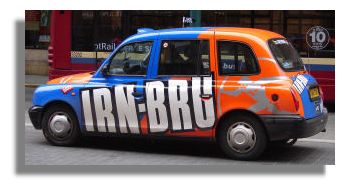
In my visit to the UK in August I ordered an Irn-Bru on board a train from London to Edinburgh. I mistook its bright orange can to mean it was an orange soda. Instead, it tastes a lot like liquified Sweet Tarts. That is to say, it's damn sweet and rather tart. I like soda - I love a good Coke - but I'm not sure how I feel about Irn Bru.
What I do adore, however, is Irn-Bru's Christmas ad; it is, as the Brits are so fond of saying, 'brilliant.' Please click the snowman below to watch. Keep an eye out for glimpses of Edinburgh's Forth Bridge, Edinburgh Castle, and the Christmas-time ice rink in Princes Street Gardens, and be sure to listen to the lyrics.
Not all of Irn-Bru's advertising over the years has been so endearing and beloved as this particular ad. Indeed, according to Wikipedia:
Over the years, advertising campaigns for Irn-Bru have caused upset. One billboard featured a young woman in a bikini along with the slogan, "I never knew four-and-a-half inches could give so much pleasure". Another featured a picture of a cow with the slogan "When I'm a burger, I want to be washed down with Irn-Bru". This billboard received over 700 complaints but was cleared by advertisement watchdogs. A billboard which featured a depressed goth and the slogan "Cheer up Goth. Have an Irn Bru." was also criticised for inciting bullying.
Irn-Bru clearly knows how to get attention. Considering their success, they seem to support the old marketing adage that "any publicity is good publicity."
To our friends and family back across the Atlantic, fear not - Irn-Bru is sold in the States! It doesn't appear to be available in the St. Louis area, but keep an eye out for that distinctive blue and orange can if you've ever wondered what would happen if you crushed up Sweet Tarts and added some water and carbonation.
Auld Lang Syne
Auld Lang Syne is the most famous of English-language New Year's songs, sung around the world throughout not only the UK but also the US, Canada, and Australia after the stroke of midnight. You may not recognize the title, but the first verse will surely bring the proper tune to mind, particularly on this, the first day of 2008.
Well, it turns out the song is Scottish! (Mark always thought it was German; one look at the lyrics below illustrates why.) No one really knows how this ballad - with words partially collected from an ancient oral tradition and partially written by Scotland's poet Robert Burns, then set to the tune of an ancient Scottish song - became so widespread. The title, like much of the song, is in the Scots language, and it translates literally into modern English as 'Old Long Since' or more poetically as 'Long, Long Ago.'
Considering the scant population (~5.1 million) of this remote, wilderness-dominated country, it's impressive to learn of the various influences it has had elsewhere in the world.
Auld Lang Syne
Should auld acquaintance be forgot,
And never brought to mind?
Should auld acquaintance be forgot,
And auld lang syne?
Chorus
For auld lang syne, my dear,
For auld lang syne,
We'll tak a cup of kindness yet,
For auld lang syne!
Verses
And surely ye'll be your pint-stowp
And surely I'll be mine,
And we'll tak a cup o kindness yet,
For auld lang syne!
We twa hae run about the braes
And pou'd the gowans fine,
But we've wander'd monie a weary fit,
Sin auld lang syne.
We twa hae paidl'd in the burn
Frae morning sun till dine,
But seas between us braid hae roar'd
Sin auld lang syne.
And there's a hand my trusty fiere,
And gie's a hand o thine,
And we'll tak a right guid-willie waught,
For auld lang syne.
Well, it turns out the song is Scottish! (Mark always thought it was German; one look at the lyrics below illustrates why.) No one really knows how this ballad - with words partially collected from an ancient oral tradition and partially written by Scotland's poet Robert Burns, then set to the tune of an ancient Scottish song - became so widespread. The title, like much of the song, is in the Scots language, and it translates literally into modern English as 'Old Long Since' or more poetically as 'Long, Long Ago.'
Considering the scant population (~5.1 million) of this remote, wilderness-dominated country, it's impressive to learn of the various influences it has had elsewhere in the world.
Auld Lang Syne
Should auld acquaintance be forgot,
And never brought to mind?
Should auld acquaintance be forgot,
And auld lang syne?
Chorus
For auld lang syne, my dear,
For auld lang syne,
We'll tak a cup of kindness yet,
For auld lang syne!
Verses
And surely ye'll be your pint-stowp
And surely I'll be mine,
And we'll tak a cup o kindness yet,
For auld lang syne!
We twa hae run about the braes
And pou'd the gowans fine,
But we've wander'd monie a weary fit,
Sin auld lang syne.
We twa hae paidl'd in the burn
Frae morning sun till dine,
But seas between us braid hae roar'd
Sin auld lang syne.
And there's a hand my trusty fiere,
And gie's a hand o thine,
And we'll tak a right guid-willie waught,
For auld lang syne.
Thursday, December 20, 2007
Craigmillar Castle

We went to Craigmillar Castle on Sunday. It is a cleverly built castle started around 1400. Its claim to fame is Mary I of Scotland, who arrived there after the birth of her son James I. It was within these walls that the plot to kill her second husband: Henry Stuart, Lord Darnley, was hatched. Darnley was later found in the gardens of Hamiltons' house, Kirk o' Field, Edinburgh, where he had been strangled to death. There had also been an explosion at that house the same night, however, it is unclear whether that was another assassination attempt, or an attempt to cover up the murder.
Craigmillar Castle is impressive upon first sight because of its machicolated battlements. The corbeled arches are not just for decoration. Between each of them is a gap, from which defenders could drop rocks or shoot arrows at attackers trying to batter or sap the castle walls. Once you get atop the battlements you can see that there are also stone drain spouts constructed over these gaps. I imagine this not only kept the defenders' catwalk dry, but also allowed them to pour hot liquids down on the attackers. Indeed, the chimneys of the fireplaces within the castle would often extend in convenient locations where a cauldron of liquid could be placed and slowly boiled. I imagine almost anything would be poured down upon the attackers, including the waste and offal of soldiers having to relieve themselves during the siege.

The round towers are also cleverly constructed, with not only the machicolated battlements once again, but also with a central, flat stone circle where a counter-siege engine or artillery piece could be mounted, or even where additional archers could kneel and fire at attackers.
The internal structure of the castle was much intact and parts even bordered on cozy. Of course, one would need plenty of tapestries and floor rugs to break up the endless cold of stone. Most of the rooms had fireplaces (a necessity in Scotland) and there seemed to be plenty of wall potties, where inhabitants could relieve themselves or where other waste could be dumped. Even the prison in the lowest level had one of these. By this time, it looked like the people were at least a little more aware of hygiene. A few outbreaks of the plague in nearby Edinburgh would do that, I suppose. Even one of the kitchens had a window carved into the an adjoining hall, which sloped down to what looked like a drain, where used broth, bones, and rotten food could be corralled and expunged.
The invention of gunpowder resulted in the adaptation of many parts of the castle. Gun ports were built atop the battlements or carved into the sides of the walls. The cannon quickly made many of the castle defenses obsolete or impractical. It is a wonder that a castle such as Craigmillar survived as intact as it did. Many others we will see have not fared so well.
Thursday, November 22, 2007
A rose is not a stone
I walk everywhere. But more importantly, I can walk everywhere. Beauty, music, and art are forever seated behind practicality. Like a man waking from a coma, I no longer require a machine to exist.
A breath is wonderful. The intake is cool, moistened air. The skin around your face and eyes are realized as it rushes into your lungs. Sometimes I covet that breath. Sometimes I forget it. Sometimes I long for the breaths I will never take. Sometimes I long for the breaths that I have taken long ago.
But here, I just breathe.
dukkha
the first of the Four Noble Truths, that all human experience is transient and that suffering results from excessive desire and attachment.
I’ve been thinking about the human condition a lot lately. And, it occurs to me, that whoever wrote this definition for dictionary.com must have really struggled to come up with this exemplification of the human condition. It took me eight pages to approach it in a paper in college. But I could have done with much less. And, of course, I was approaching it from a Western tradition.
But there it is. It is a terrifying, comforting Truth. The castle that I see every day has held prominence for 900 years. But it is nothing. Like everything built, it will fall. Not in my lifetime, but perhaps in a hundred. It is a fresh, moist breath in the ebb and flow of existence. The generals and kings that fought for their ideals and their pockets are gone and may be remembered, but are ultimately transient. They are as transient as the waif on North Bridge, begging for my pence. Pence, power, warmth, or recognition. Security. Permanence. Permanence-desire in the absence of permanence is suffering.
Steps tick like heartbeats,
In a timeless city marked by timely monuments;
A thousand ghosts in the weathered stones
Suck the allusion from the plucked rose.
Here am I and am not,
Here was and never was.
A rose is not a stone.
A breath is wonderful. The intake is cool, moistened air. The skin around your face and eyes are realized as it rushes into your lungs. Sometimes I covet that breath. Sometimes I forget it. Sometimes I long for the breaths I will never take. Sometimes I long for the breaths that I have taken long ago.
But here, I just breathe.
dukkha
the first of the Four Noble Truths, that all human experience is transient and that suffering results from excessive desire and attachment.
I’ve been thinking about the human condition a lot lately. And, it occurs to me, that whoever wrote this definition for dictionary.com must have really struggled to come up with this exemplification of the human condition. It took me eight pages to approach it in a paper in college. But I could have done with much less. And, of course, I was approaching it from a Western tradition.
But there it is. It is a terrifying, comforting Truth. The castle that I see every day has held prominence for 900 years. But it is nothing. Like everything built, it will fall. Not in my lifetime, but perhaps in a hundred. It is a fresh, moist breath in the ebb and flow of existence. The generals and kings that fought for their ideals and their pockets are gone and may be remembered, but are ultimately transient. They are as transient as the waif on North Bridge, begging for my pence. Pence, power, warmth, or recognition. Security. Permanence. Permanence-desire in the absence of permanence is suffering.
Steps tick like heartbeats,
In a timeless city marked by timely monuments;
A thousand ghosts in the weathered stones
Suck the allusion from the plucked rose.
Here am I and am not,
Here was and never was.
A rose is not a stone.
Subscribe to:
Posts (Atom)